

Roles Amidst Madness
The year is 2020.
A virus has come to nest itself amongst bodies.
One may assume that a global health issue will unite society to work in favor of humanness, unity, and equality. Instead, the pathogen reigns, multiplying with idiocracy. White supremacy and police brutality continue to transcend.
The racists |the hidden plenty| are conspicuously standing on their pedestals, waving their guns because of their American Rights.
Black lives are in danger.
The time for awakening is now, amidst the madness in the interim of movements and deaths.
Black lives are in danger.
The world is demanding to take your role. Its voice hovers by my ear (and probably yours too) continuously booming, restless I weep. This voice demands my position, tugging until I dispose of the fear and realize that I am part of the embodiment of a perpetual battle. There is a state of panic. Each individual hears a call to fulfill their task, to recognize truths, and to educate oneself.
The Blooming of a Black Consciousness
I am an Afro-Dominican woman who is six years deep into Blackness. To its meaning, glory, history, and all that it epitomizes. For about eighteen years, I moved unplugged, an unwatered consciousness untethered from the womb of knowledge; I existed without the proper nutrition of my history and identity.
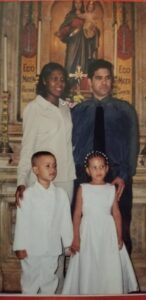
Before I arrived in Chicago, in the Summer of 2014, I identified as Dominican. I knew nothing else. My mother and her side of the family are dark-skinned with hair that is coarse and coiled from San Cristóbal. My father is lighter-skinned, straight hair that is black from the Northern part of Santo Domingo, of Spaniard descendants. Birthed from the mixing of café negro y leche, I came café con leche-toned with pelo malo (bad hair, as the Dominicans say).
In New York City they raised me amongst a mix of cultures.
*pelo malo: a term used in the Latinx community to refer to curly, textured, and kinky hair as bad hair.
Identity Crisis in the Latinx Community
My family members were not taught their history, nor about their lineage to African descent. If they were, I would have learned it and not have wondered out oblivious in the world. A handful of memories sit miles deep into my mind of the moments that a profound conversation could have occurred about our identity.
These times included the words of my uncle, a pirata who would respond when stopped by the cops, “I just tell them I’m Black, that’s what I am, there’s no need to explain that I’m Dominican.”
Enlightenment to these circumstances did not come until way down the line.
*pirata: a term used to describe a gypsy cab driver.
Blanquita Privilege
The New York City education system failed me in not teaching me about my blackness and black history. When I arrived in Chicago with my Colombian/Dominican white-passing best friend, the world was quick to teach me about colorism and the distaste there is for black features. Like a chant, people asked if I was mixed because of my hair, accent, and features.
I remember my classmate Janelle asking me if I wanted to join the Black Student Union in school (SAIC). I never told her the impact that specific moment had on me. She pushed me to become in tune with my identity; to plunge into the history of my ancestors.
“Am I black? ” I asked myself at the end of my freshman year during a summer class. I never joined for fear that I was not black enough and mostly because I was afraid of my lack of education about myself and lineage.
It took a traumatizing event during my sophomore year to teach me more about my identity, while also revealing the racism in my own Dominican/Latinx community. It came down to me deciding to choose my blackness while my best friend escaped into the safety of whiteness, submerging herself into her Latinidad. She allowed her mother to spit the deepest racial slurs that most anti-black mothers keep in their purses when it comes time to keeping their daughters from sharing love with black boys.
In a ferocious-Spanglish over the phone rant, this Colombian mother told me that her daughter and I are Latinas and should not be dating black boys. She said that I was a bit luckier for having an exotic boyfriend whose black and Asian, but there would be absolutely no way that her daughter could be with a Mississippi black boy.
At the age of twenty-two I would learn one of the biggest lessons of my life.
I respond to this event in a poem titled Tu Mama.
Diasporic Blackness with Arturo Alfonso Schomburg
Amongst those who I’ve learned from about the African Diaspora experience is Arturo Alfonso Schomburg, born in Puerto Rico of African and German lineage. He identified as Afro-Latino. The way the story goes of what sparked Schomburg to become an autodidact, book collector and archivist, writer, and institutional builder was his experience in grade school. Wanting to prove his teacher wrong about the statement made towards black people not being part of the accomplishment contributed to society, education, and the arts, he set out to find these things.
And so he did.
In Diasporic Blackness: The Life and Times of Arturo Alfonso Schomburg by Vanessa K Valdés, the book examines the difficulties and fruits of the multiplicities of identity that Schomburg faced, as well as other educators of mixed races that he interacted with throughout his life.
I found this text to be a treasure at this point in my life, helping me to decipher more of my experience as an Afro-Latina. Like Schomburg, I feel that I must share my experience from the Black and Latinx lens.
Generational Misunderstanding
An ongoing theme in my poetry is about breaking cycles. These cycles include breaking from domestic abuse, trauma, and the lifestyles I watched people fall into while I grew up in New York City.
When I arrived in Chicago, I thought all was well, having believed I ran from those ordeals. Instead, the beginning years of my young adulthood accumulated the burdens of the past constructing a convoluted centaur for me to face. Identity was now the top tier. I succumbed, feeling like I did not have the proper tools to move forward, nor the knowledge to begin to dismantle my obstacles. I had to re-learn myself: knowing who I am, accepting my blackness and that I am not just Dominican has resurrected me once more in this lifetime.
Afro-Descendant Consciousness
I dedicate an ode to my hair and the Dominicana that was on a phone call half paying attention, chopping off all my hair on the late afternoon of August in 2014, when I only asked her to take a few inches. To this day, I am told by the people back home, those who may still wonder about their own identity and denying it, through harsh critique telling me that I have pelo malo or to fix my hair and straighten it. As trivial as this may seem, it is part of my journey of accepting my blackness.
Be First to Comment